
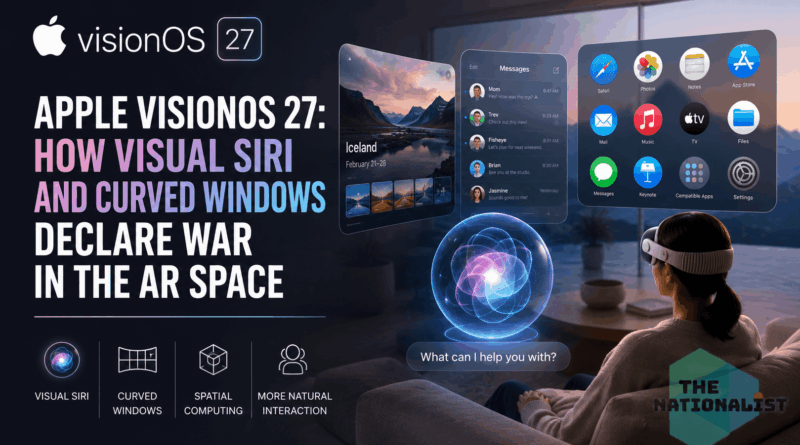
Apple visionOS 27: How Visual Siri and Curved Windows Declare War in the AR Space
A New Chapter in Spatial Computing
When Apple unveiled visionOS 27, many dismissed it as another incremental update. A closer look reveals something far more ambitious: a calculated escalation in the battle for AR and VR dominance. With AI-powered Visual Siri and redesigned curved windows at its core, visionOS 27 is Apple’s clearest signal yet that it intends to own spatial computing — leaving Meta, Google, and Snap scrambling to respond.
Visual Siri: AI as the Core Operating Layer
The most transformative element of visionOS 27 is the deep integration of Visual Siri into the spatial interface. Earlier versions of Siri sat on the periphery as a voice-activated assistant. Now, Visual Siri operates as a persistent, context-aware AI layer woven into the environment itself. Powered by advanced machine learning models running on-device and through cloud infrastructure, it interprets what a user is looking at, anticipates their next action, and surfaces relevant information — no spoken command required.
This is a significant leap forward. Meta’s mixed reality platforms lean heavily on social connectivity and gaming. Google’s AR efforts have felt fragmented across mobile and desktop ecosystems. Apple’s approach — using AI as the invisible operating layer of spatial computing — creates a fundamentally different user paradigm. The experience becomes proactive rather than reactive, intelligent rather than mechanical.
Curved Windows and the Geometry of Spatial Dominance
visionOS 27 also introduces a redesigned windowing system built around organic, curved surfaces. This is more than a cosmetic change. Curved windows reduce visual fatigue during extended sessions, making the headset genuinely viable for productivity beyond entertainment. For enterprise users managing IoT dashboards, monitoring cybersecurity threat feeds, or overseeing robotics and automation workflows, a comfortable and spatially intuitive interface is a necessity, not a luxury.
The curved window system also reflects Apple’s core design philosophy: hardware and software must feel unified. Competing headsets from Meta and Snap have often paired powerful hardware with interfaces that feel bolted on. Apple’s curved windows signal that spatial computing should feel as natural as looking through a physical window — not like navigating a flat screen floating in mid-air.
The Competitive Battlefield: Meta, Google, and Snap
Understanding visionOS 27 means understanding the competitive pressure Apple faces. Meta has invested billions in Reality Labs, building an ecosystem of software, social tools, and developer incentives. Google has re-entered AR with renewed focus on enterprise applications, leveraging its strength in cloud computing and data infrastructure. Snap continues to innovate at the consumer end with lightweight AR glasses built for everyday social interaction.
Apple’s response to each threat is embedded in visionOS 27. Against Meta’s social ecosystem, Apple counters with AI depth through Visual Siri. Against Google’s enterprise cloud strategy, Apple offers on-device processing that appeals to organizations prioritizing cybersecurity and data sovereignty. Against Snap’s lightweight consumer appeal, Apple bets on premium experience and seamless integration across its broader ecosystem of mobile devices, laptops, wearables, and smart home products.
Emerging Technologies Converging on One AI Platform
visionOS 27 is also a convergence point for multiple emerging technology trends. Quantum computing research is already influencing how Apple designs encryption protocols for spatial data. Blockchain frameworks are being explored for verifying digital ownership of spatial objects and environments. Mobile app development is being reshaped as developers must now think in three dimensions rather than two. Robotics and automation engineers are prototyping spatial interfaces for controlling robotic systems through visionOS environments.
This convergence is intentional. Apple is positioning visionOS not as a niche platform but as the foundational AI-driven layer for how humans will interact with technology across every domain in the coming decade.
Conclusion: A Strategic Statement, Not Just a Software Update
visionOS 27 should be read as a strategic document as much as a software release. Through Visual Siri’s AI-driven intelligence and the ergonomic sophistication of curved windows, Apple has drawn a clear line in the spatial computing landscape. The message to Meta, Google, and Snap is unmistakable: casual experimentation in AR is over. The war for the spatial future has begun, and Apple is playing to win.